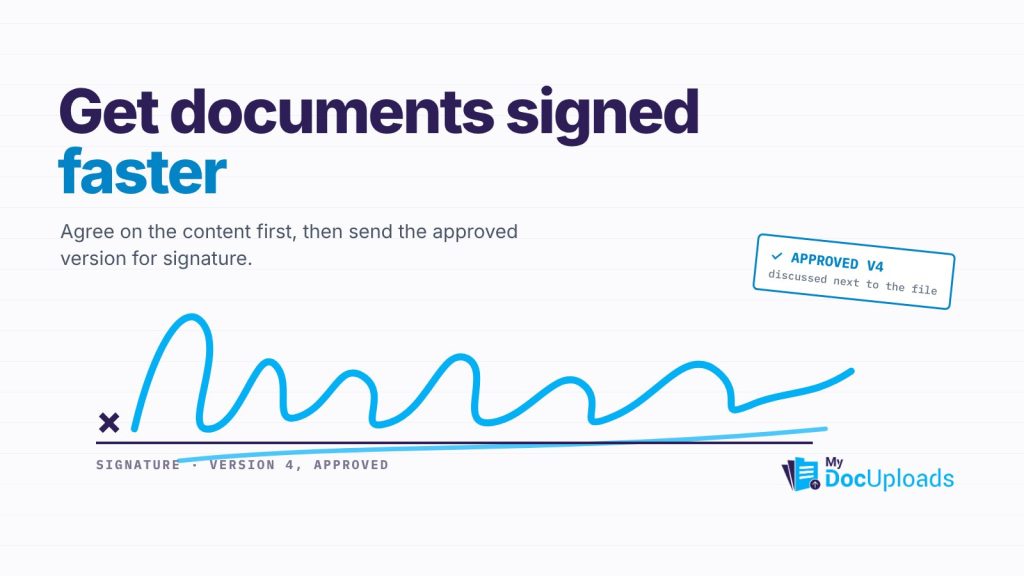
The fastest way to get documents signed online is to settle the content first and send for signature second. Most signing delays aren’t about the signature at all: the client is still unsure about a clause, has the wrong version, or can’t find the link in their inbox. Agree on the final version next to the file, then send that exact PDF for e-signature from the same place.
Here’s how to set that up, and a checklist to run before anything goes out.
Why documents sit unsigned
When an engagement letter or agreement stalls, the cause is usually one of these:
- An open question. The client has a concern about the fee clause and is waiting to raise it on a call.
- Version confusion. There are three drafts in their inbox and they aren’t sure which one is final.
- Too much at once. Fifteen fields on twelve pages, with no clear starting point.
- Unclear ownership. Two signers, and each assumes the other is handling it.
- A hard-to-find link. The request arrived a week ago under a subject line nobody remembers.
Every one of those is a process problem, and every one is fixable before you press send.
Step 1: Agree on the content, next to the file
Put the draft in the client’s workspace and discuss it there. In MyDocUploads Conversations, every file has its own thread beside the preview. The client asks about section 4, you reply with the revision, and the history stays attached to the document instead of scattered across email.
When everyone agrees, mark the file approved. Mark Approved locks the thread to read-only, so the record of what was agreed can’t be edited afterwards. If something needs to change later, a workspace administrator can request changes to reopen it, and both decisions are recorded.
This step is what makes the signature fast. By the time the signing request arrives, there’s nothing left to discuss.
Step 2: Send the approved PDF for signature
Send that same approved file for e-signature from the workspace. With MyDocUploads Sign, you upload or pick the PDF, place your own signing fields, and invite recipients. Signers get a secure link and don’t need an account. You can see who has and hasn’t signed, and the completed copy lands back in the same workspace with the rest of that client’s files.
The signing record includes the time, device and location of each signature. That matters because, under the federal ESIGN Act, a signature or contract can’t be denied legal effect solely because it is electronic. Keep in mind that some document types are excluded, including wills and certain family law and court documents, and state rules can add their own requirements. If you’re unsure whether a document can be signed electronically, check before you send.
Step 3: Make the request easy to finish
The signing request itself should take a client a few minutes. A few habits help:
- Only the fields that matter. Signature, date and initials where they’re genuinely needed. Fill in names and addresses yourself.
- Say what it is and why. “Here is your engagement letter for the 2026 tax year, as we discussed. It needs one signature on page 3.”
- Name every signer up front. If a spouse or business partner also signs, tell both of them before the request arrives.
- Give a reason for the date. “We need this back by Friday to file the extension” gets a faster reply than “at your earliest convenience.”
A pre-send checklist
Run through this before any document goes out for signature:
- Is this the approved version, and is the conversation on it marked approved?
- Are all names, dates, amounts and addresses filled in?
- Are signing fields placed only where a signature, initials or date is required?
- Does every signer know they’re signing, and in what capacity?
- Is this a document type that can be signed electronically?
- Did you write one sentence explaining what the document is and when you need it back?
- Will the completed copy land somewhere the whole team can find it?
Forms and signatures are different jobs
It’s tempting to add a “sign here” box to an intake form. Don’t. A form collects information; a signature needs its own record of who signed, when and on which version of the document. In MyDocUploads, forms live in MyDocUploads Flow and signatures live in Sign, so each does its own job, and form submissions never use up your signature requests.
The same logic applies to anything else sensitive that comes up during signing. If a client needs a portal login to complete the next step, send it through a Secure Drop, not in the body of the signing request.
What “faster” really looks like
A faster signature isn’t a cleverer reminder email. It’s a document that arrives already agreed, in a single clear request, from the same place the client has been reviewing it. Get the first two steps right and the signature is usually the quickest part.
If you’d like to try this with your next engagement letter, you can start a 14-day trial of MyDocUploads.
This article is general information, not legal, tax or professional advice for your specific situation.
Frequently asked questions
Do signers need an account to sign?
No. In MyDocUploads Sign, signers open a secure link and complete their signature without creating an account.
Are electronic signatures legally valid?
Under the federal ESIGN Act, a signature or contract can’t be denied legal effect solely because it is electronic. Some documents are excluded, including wills and certain family law and court documents, and state rules may add requirements.
What does Mark Approved do?
It records that a file has been agreed and locks that file’s conversation to read-only, so the record of what was agreed can’t be edited. A workspace administrator can request changes to reopen it, and both decisions are recorded.
Can I collect a signature in an intake form?
No. Forms collect information and signatures need their own signing record. In MyDocUploads, use Flow forms for intake and Sign for signatures on PDFs.